- Solved Files Newsletter
- Posts
- “He Armed a Killer” — First Parent Ever Convicted of Murder in School
“He Armed a Killer” — First Parent Ever Convicted of Murder in School
This Week’s Most Gripping True Crime Stories You Can’t Miss

David Yupa
March 13, 2026

Welcome Back Case Crackers!
Welcome back to another edition of Solved Files, your weekly deep dive into the world’s most shocking, puzzling, and mind-boggling true crime stories. This week, we’re bringing you a verdict that made legal history and sent shockwaves through every parent in America who owns a firearm.
On March 3, 2026, a Georgia jury took less than two hours to convict Colin Gray on all 27 counts, including second-degree murder, involuntary manslaughter, and cruelty to children. His crime? Giving his 14-year-old son an AR-15 rifle as a Christmas gift, despite knowing the boy had made threats and was struggling with mental health issues.
Seven months later, that same rifle was used to kill four people and wound nine others at Apalachee High School in Winder, Georgia, on September 4, 2024.
Colin Gray is now the first parent in American history to be convicted of murder for their child’s school shooting. Not manslaughter. Not negligence. Murder. He faces up to 180 years in prison.
This case has ignited a national debate: When does parental negligence become criminal culpability? When does giving your child a gun make you an accomplice to mass murder? And what message does this verdict send to parents across America?
As always, we’ll break down the facts, examine the evidence that convicted him, and show you why this jury decided that Colin Gray’s actions directly caused the deaths of four innocent people. Plus, this week’s bizarre crimes, statistics, and more.

🔎 Full Case Story — The Shooting That Changed Everything

Colin Gray in court during his murder trial
On September 4, 2024, at approximately 10:20 a.m., 14-year-old Colt Gray walked into Apalachee High School in Winder, Georgia, armed with an AR-15 rifle. He opened fire, killing four people and wounding nine others.
The victims who died were:
Mason Schermerhorn, 14, student
Christian Angulo, 14, student
Richard Aspinwall, 39, math teacher and assistant football coach
Cristina Irimie, 53, math teacher
Colt was apprehended at the scene and charged as an adult with felony murder. But investigators didn’t stop there. They turned their attention to his father, Colin Gray, and what they discovered led to unprecedented charges.
The Gun Was a Christmas Gift
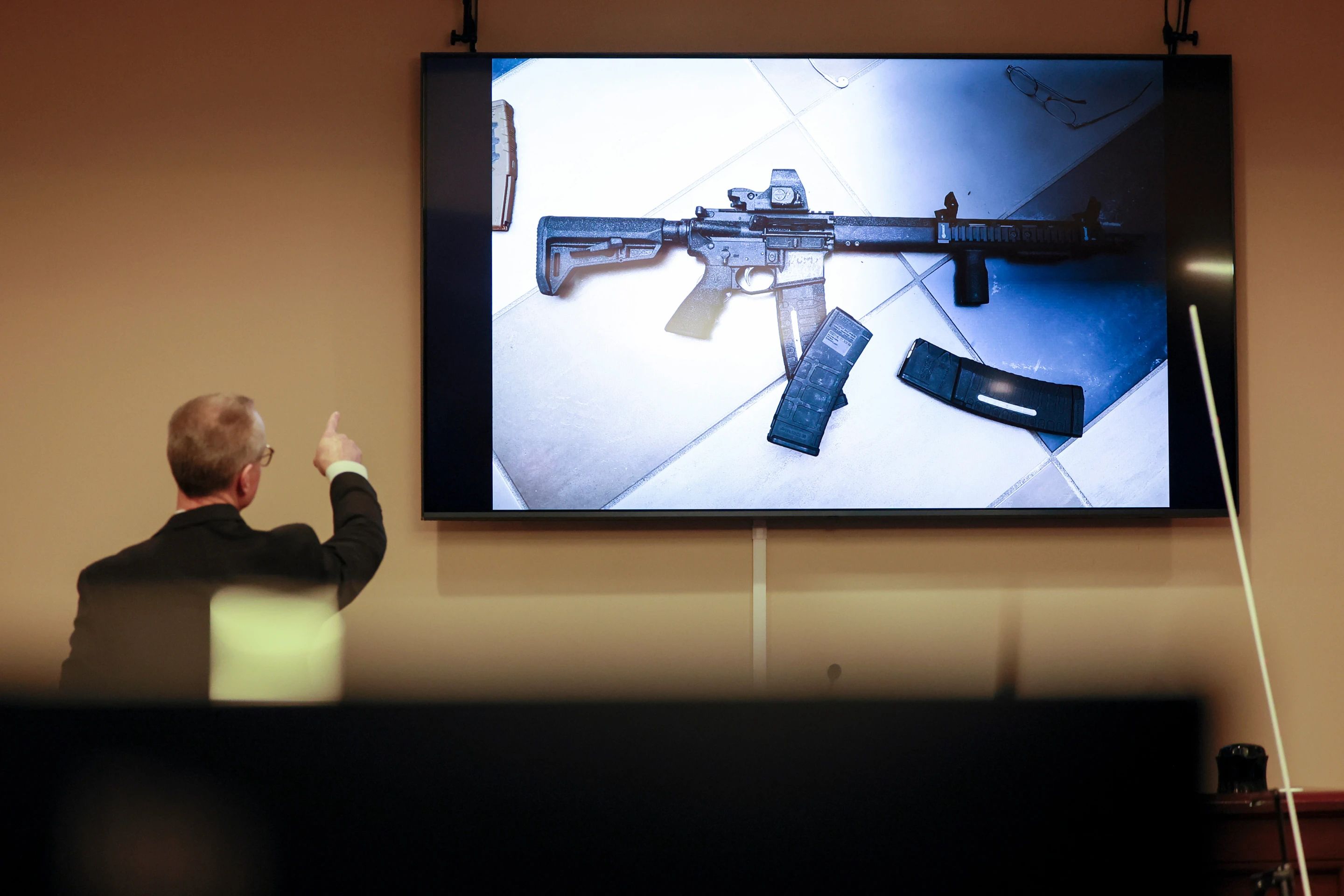
Prosecutor displays the AR-15 rifle used in the Apalachee High School shooting during Colin Gray's trial at Barrow County Courthouse
In December 2023, Colin Gray gave his 14-year-old son an AR-15 rifle as a Christmas present. Photos shown in court depicted Colt posing with the weapon, smiling. This might not have been criminal on its own, but prosecutors argued Colin knew his son was dangerous.
The FBI Visit Colin Ignored
In May 2023, four months before Colin gave Colt the AR-15, the FBI and sheriff’s deputies came to the Gray home investigating online threats to commit a school shooting traced to an account possibly linked to Colt.
Both denied the threats. The FBI couldn’t prove Colt made them, so no charges were filed. But the visit put Colin on notice: law enforcement believed his son might be planning school violence.
Despite this warning, Colin bought Colt the AR-15 seven months later.
Text Messages Showed Colin Knew
Prosecutors presented text messages showing Colin was aware of Colt’s mental health struggles and violent thoughts. In exchanges shown to the jury, Colt expressed anger and talked about wanting to hurt people. Colin’s responses were dismissive rather than seeking help for his son.
Evidence also showed Colt had easy access to the gun safe where the AR-15 was stored. Colin had not secured the weapon despite knowing about the FBI investigation.
The Prosecution: “He Armed a Killer”
Lead prosecutor Jared Williams argued: “This defendant didn’t pull the trigger, but he armed the shooter. He gave his son the tool to commit mass murder knowing his son had been investigated for threatening to do exactly what he did.”
The prosecution’s evidence included:
The FBI visit proving Colin was on notice
Text messages showing Colin knew about Colt’s violent thoughts
Proof that Colt had unsecured access to the AR-15
Expert testimony that Colin’s actions violated basic gun safety principles
“Mason Schermerhorn was 14 years old. Christian Angulo was 14 years old. They’re dead because this defendant put a gun in his son’s hands and looked the other way,” Williams told the jury.
The Defense: “He’s a Parent, Not a Murderer”
Colin’s defense attorney argued he made mistakes as a parent but didn’t commit murder. The defense emphasized:
Colin never believed Colt would actually commit violence
The FBI didn’t file charges, suggesting insufficient evidence of real threat
Millions of parents give children firearms for hunting
Colin couldn’t predict or control his son’s actions
“Colin Gray is guilty of being a bad parent, but being a bad parent is not the same as being a murderer,” the defense told the jury.
The jury disagreed.
The Verdict: Guilty on All 27 Counts
On March 3, 2026, after less than two hours of deliberation, the jury returned guilty verdicts on all 27 counts:
Two counts of second-degree murder (Mason Schermerhorn and Christian Angulo)
Two counts of involuntary manslaughter (Richard Aspinwall and Cristina Irimie)
23 counts of cruelty to children (every student placed in danger)
Colin Gray showed no emotion. Victims’ families wept.
Why Murder and Not Just Manslaughter?
The second-degree murder convictions require proof that Colin’s actions showed “reckless disregard for human life.” The jury found that giving a troubled teenager an AR-15 after an FBI warning met that standard.
Under Georgia law, you commit second-degree murder when you cause death while showing reckless disregard for human life. The jury found Colin didn’t just make a mistake—he made a choice any reasonable person would know could result in deaths.
Sentencing: Up to 180 Years
Colin Gray faces:
Up to 40 years for second-degree murder counts
Up to 20 years for involuntary manslaughter counts
Up to 120 years for cruelty to children counts
Maximum possible sentence: 180 years in prison.
Sentencing is scheduled for May 2026. Legal experts expect consecutive sentences, meaning Colin could spend the rest of his life behind bars.
Historic Precedent
Colin Gray is the first parent in U.S. history convicted of murder for their child’s school shooting. Previous cases resulted in manslaughter or lesser charges, but never murder.
This verdict sends a clear message: if you give a weapon to a child you know is dangerous, and that child kills people, you can be held criminally responsible for those deaths.
The case is expected to influence prosecutions nationwide. Parents who enable their children’s access to firearms despite warning signs may now face murder charges.
The Impact
Victims’ families praised the verdict. “This man put the gun in his son’s hands knowing what could happen,” said the mother of one wounded student. “He’s as guilty as the shooter.”
Gun rights advocates criticized it as government overreach. “This criminalizes gun ownership and parenting,” one group said.
Legal scholars say the case represents a shift in parental responsibility for juvenile violence. “This verdict says: if you arm a killer, you’re responsible for the killing,” one professor noted.
Colin Gray now sits in a Georgia jail awaiting sentencing. His son awaits trial for murder. Four families will never see their loved ones again. And America continues grappling with the question: Who is responsible when a child commits mass murder?

Facts vs Myth
Myth: Parents can’t be charged for crimes their children commit.
Fact: Parents can be charged if they knowingly enable their child’s crime. Colin Gray is the first parent convicted of murder for a child’s school shooting, proving parental responsibility can cross into criminal liability.
Myth: Giving your child a gun is always legal if it’s for hunting or sport.
Fact: It becomes criminal if you know or should know the child is dangerous. The FBI visit and text messages proved Colin Gray knew his son was a threat.
Myth: You have to pull the trigger to be guilty of murder.
Fact: Under Georgia law, providing the weapon with reckless disregard for human life can make you guilty of second-degree murder. Colin didn’t shoot anyone, but he armed the shooter.
Myth: Gun safes are legally required to keep firearms away from minors.
Fact: Georgia has no such law, but juries can still find you criminally negligent if you fail to secure weapons from a child you know is dangerous.
👉 Bottom Line: If you own firearms and have children, secure them. If your child shows warning signs, get help. Ignoring red flags can now result in a murder conviction.

Tip of the Week
Secure your firearms if you have children. Even if your state doesn’t legally require it, gun safes and trigger locks can prevent tragedies. Colin Gray faces 180 years because he didn’t.
Take threats seriously, even from your own child. If law enforcement visits your home to investigate threats, that’s a massive red flag. Get your child professional help immediately.
Warning signs are not false alarms. Isolation, violent ideation, talk of hurting others, these are not phases. They’re cries for intervention. Ignoring them can cost lives and your freedom.
Know your state’s laws on parental liability. More states are holding parents criminally responsible when children commit gun violence. Ignorance of the law is not a defense.
If you’re a parent and gun owner, you have a dual responsibility. You must teach responsible gun ownership AND recognize when your child should not have access to weapons, period.
👉 Weekly Reminder: This verdict proves that “I didn’t think he’d actually do it” is not a defense. If you arm someone you know is dangerous, you can be convicted of murder.
📊 By The Numbers: School Shootings and Parental Accountability
The Colin Gray case sits at the intersection of two American crises: school shootings and parental responsibility. Here are the statistics:
There have been over 400 school shootings in the U.S. since Columbine in 1999
This includes incidents where a gun was fired on school property, whether or not anyone was injured.
77% of school shooters obtained their weapons from home
The vast majority of juvenile school shooters use guns taken from their own homes or the homes of relatives.
Only 12% of parents of school shooters have faced criminal charges
Until recently, parents were rarely prosecuted. That’s changing rapidly.
Juvenile access prevention laws exist in only 27 states
These laws hold adults criminally liable if they negligently store firearms and a minor gains access. Georgia does not have such a law, yet Colin Gray was still convicted.
School shootings have increased 47% in the past decade
From 2014 to 2024, the number of school shooting incidents rose dramatically, prompting calls for greater parental accountability.
The average school shooter shows warning signs months in advance
Studies show that most school shooters exhibit concerning behavior, make threats, or show signs of mental health crises before committing violence.
Parents who are prosecuted face an average of 10-15 years in prison
Before Colin Gray, the harshest sentence for a parent was 15 years. Colin faces up to 180 years, setting a new precedent.
💡 What This Means:
The Colin Gray verdict signals that America is shifting how it views parental responsibility in school shootings. If you own guns and have children, the legal standard is rising. Warning signs ignored can now result in murder convictions.
Case Crackers
Think you’ve got sharp detective instincts? Let’s test them.
The FBI visited Colin Gray’s home in May 2023 to investigate online threats possibly made by his son Colt. Seven months later, Colin gave Colt an AR-15 for Christmas. Seven months after that, Colt used it to kill four people.
Here’s the question:
👉 What was the MOST damaging piece of evidence that proved Colin Gray’s guilt?
Was it:
A. The FBI visit in May 2023 that put him on notice his son was dangerous
B. Text messages showing Colin knew about Colt’s violent thoughts
C. The fact that he gave Colt unsecured access to the AR-15
D. All of the above combined to show reckless disregard for human life
Take your pick. In this case, it wasn’t one smoking gun, it was a pattern of ignoring every warning sign until four people were dead.
🔎 Detective’s Extras
Why This Case Made History
Colin Gray is the first parent ever convicted of murder (not manslaughter) for a child’s school shooting. Here’s why that distinction matters:
Manslaughter = You caused death through negligence or recklessness, but didn’t intend harm.
Second-Degree Murder = You caused death through actions that showed reckless disregard for human life.
The difference is intent and awareness. The jury found that Colin Gray wasn’t just negligent. He knew his son was dangerous, knew giving him a gun could result in deaths, and did it anyway. That’s reckless disregard, which meets the legal standard for murder.
What “Reckless Disregard” Means in Georgia Law
Georgia law defines second-degree murder as causing death “by committing an act or acts which demonstrate a reckless disregard for human life.”
The prosecution had to prove:
Colin’s actions caused the deaths
His actions showed reckless disregard for human life
A reasonable person would have known the danger
The FBI visit checked all three boxes. Any reasonable parent, after being told their child might be planning a school shooting, would secure weapons and get help. Colin did the opposite.
How This Changes Parental Liability
Before this case, parents faced manslaughter or negligence charges. Now, they can face murder charges if they knowingly enable violence.
This verdict establishes that:
Warning signs create a legal duty to act
Ignoring those warnings can be criminal
Providing weapons despite warnings = reckless disregard = murder
The Cruelty to Children Charges
Colin was convicted of 23 counts of cruelty to children, one for every student who was present during the shooting and placed in mortal danger.
Georgia law defines cruelty to children as “maliciously or willfully” causing a child cruel or excessive pain or suffering. The prosecution argued that by enabling the shooting, Colin subjected every child in that school to terror and trauma.
This creative charging decision allowed prosecutors to maximize Colin’s potential sentence and recognize every child who was victimized.
👉 Quick Think: If your child is investigated by the FBI for threatening school violence, what’s the right response? (Hint: It’s not buying them an AR-15 for Christmas.)

💬 Community Q&A — We Want Your Voice!
We love hearing from our Case Crackers community, and your insights shape how we build each edition. This week, we’re asking:
What do you find most gripping in Solved Files?
• Do you prefer deep-dive case breakdowns like the Schur story, or more quick-hit crime stats and myths vs facts?
• Are exclusive sneak peeks and behind-the-scenes materials something you’d want more of each week?
• Should we introduce guest expert Q&As (lawyers, detectives, forensic analysts) to add fresh voices?
💬 Your opinion matters, don’t hesitate to share your thoughts! Drop us a reply or fill out this quick feedback form HERE . Together, we’ll make Solved Files your go-to hub for true crime insights and interactive casework.
Got another burning question or case request? Send it in — you might see it featured in next week’s Q&A spotlight!
Ethical Debate — What Would You Do?
The Colin Gray verdict raises profound questions about parental responsibility, gun ownership, and where society draws the line between negligence and murder.
The Scenario:
Your 14-year-old son has been struggling. He’s isolated, angry, and has been bullied at school. One day, the FBI shows up at your door investigating online threats to commit a school shooting that may be linked to your son. The investigation is inconclusive, no charges are filed, but you’ve been warned.
Months later, your son asks for a gun for Christmas. He wants to go hunting with you, just like you did with your father. It’s a family tradition. You believe teaching him responsible gun ownership will help him build confidence and discipline.
What would you do?
Discussion Points:
Parental Judgment vs. Legal Duty
• Do you have the right to trust your own judgment about your child, or does an FBI warning create a legal duty to deny access to firearms?
• Where’s the line between being a trusting parent and being criminally negligent?Second Amendment Rights vs. Public Safety
• Does the Second Amendment protect your right to give your child a firearm even after law enforcement warnings?
• Should gun ownership rights be suspended when a minor has been investigated for violent threats?Mental Health Stigma vs. Intervention
• If every troubled teenager were denied access to guns, would that unfairly stigmatize youth mental health issues?
• Or is denying access to deadly weapons a common-sense response to warning signs?Parental Accountability vs. Individual Responsibility
• Is it fair to hold Colin Gray responsible for his son’s decision to kill?
• At what point does enabling become accomplice liability?
• Where does parental responsibility end and the child’s own culpability begin?Hindsight Bias
• Would we be having this conversation if Colt hadn’t committed the shooting?
• Are we judging Colin’s parenting decisions based on the tragic outcome rather than what he knew at the time?
• How many parents give their troubled teens firearms without incident?
The Jury’s Answer:
The jury decided that Colin Gray crossed the line from bad parenting into criminal liability. They found that:
• The FBI visit was a clear warning
• Ignoring that warning while giving access to an AR-15 showed reckless disregard for human life
• Four deaths were the foreseeable result of that recklessness
Your Turn:
If you were on the jury, would you have convicted Colin Gray of murder? Or would you have found him guilty only of lesser charges like manslaughter or child endangerment?
Consider:
• Would your answer change if the FBI visit never happened?
• Would it change if Colin had locked up the gun but Colt broke into the safe?
• Would it change if Colt had killed only one person instead of four?
The Bigger Question:
Should American law hold parents criminally responsible when their children commit mass murder? Where do we draw the line between tragedy and crime?
Some argue this verdict unfairly criminalizes parenting mistakes and gun ownership. Others say it’s long overdue accountability for parents who arm dangerous children.
What do you think?

🔦 🔒 Step Inside the Evidence Vault
Every week in this newsletter, you get the key facts of each case. But there’s a side of true crime we can’t show here — raw photos, full reports, and uncensored evidence too sensitive for public release.
That’s why we built a private space for our most dedicated Case Crackers — on Patreon.
When you join, you’ll unlock:
📂 Exclusive crime scene and evidence photos — the same images investigators analyzed, including rare suspect and victim visuals.
🎥 Uncensored interrogation and footage access — the clips too intense or restricted to post publicly.
🕵 Behind-the-scenes breakdowns — discover how real detectives piece together motive, timeline, and truth.
💬 Community discussions — join other true crime enthusiasts to debate theories, spot clues, and share insights.
Here’s a small preview of what’s waiting inside:
 Exclusive suspect image — full case file available only on Patreon |  Exclusive evidence photo — complete collection inside the vault |
And that’s just the beginning. Patreon members get full access to complete photo sets, classified-level case notes, and uncut footage that brings every investigation to life.
👉 Join Solved Files on Patreon today and step inside the vault of unfiltered true crime.
📲 Follow Us Everywhere
Want daily updates and quick case clues? Find us here:
TikTok & Instagram: Crime polls, case clues, and behind-the-scenes breakdowns.
Solved Files Shorts: The biggest shocks in under a minute — moments that prove the smallest details can crack a case wide open.
💡 Thanks for following along this week. Every investigation is another puzzle piece, and together, we’re piecing the truth into focus. Stay sharp, stay curious, and remember: the next clue is always closer than you think.